Accelerating Frontier AI: Our Investment in Fractile
Every token a language model produces starts with a trip to memory. For a quick chat reply, that trip is barely noticeable. For a coding agent grinding through a large codebase, or a reasoning model working through a long chain of thought, those trips add up so quickly that the chips doing this work spend far more of their time waiting on data than crunching numbers.
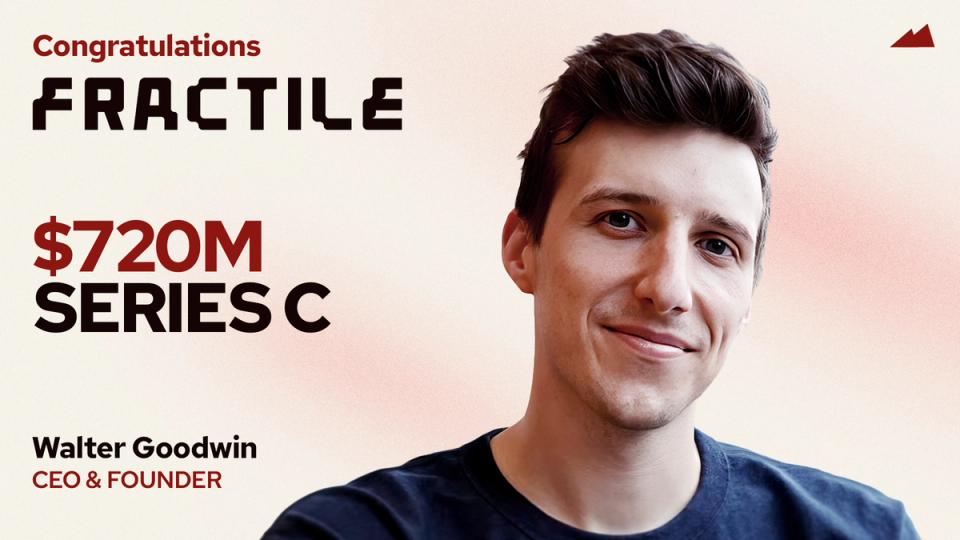
As inference workloads shift toward agentic, long-running, reasoning-heavy work, the bottleneck isn’t how many FLOPS a chip can push, but rather how fast it can move weights and KV cache out of memory, token after token, for tasks that can run for minutes or hours. Inference is how AI is consumed through real products, and we believe it is constrained by memory, not compute. That conviction is why we’re excited to partner with Walter Goodwin and the team at Fractile, a chip-first frontier AI company that is building the hardware that determines how fast and how far the most capable AI systems can go.
Why Now
For many years, most of the capital investment and attention in AI went to training infrastructure. But as models spend more time thinking at runtime and agents take on longer-running tasks, inference has quickly become the larger and faster-growing part of AI compute, introducing a new bottleneck for AI hardware.
To date, chip designers have needed to make trade-offs while serving AI inference. For example, GPUs have significant memory capacity and computing density but limited bandwidth, and SRAM-based accelerators have bandwidth but not enough capacity to hold long context for agents or frontier-scale models. That trade-off was tolerable when workloads were short and models were smaller. The workloads that will create the most value in AI over the next several years, long-running agents and reasoning-heavy applications, are exactly the ones that run into it hardest.
This problem demands a new kind of hardware to enable capabilities that AI hardware has never delivered before. But, this isn’t just a question of which chip is cheaper to serve AI models on. The underlying systems we build now will determine what the next generation of models and agents will be able to do at all.
What Fractile is Building
Fractile’s goal is to build a fundamentally better hardware for the highest-value work in AI inference. The solution is a new kind of processor in which memory and compute are interleaved, rather than sitting apart with a narrow link between them. Matching the speed of the fastest specialized chips without giving up the memory capacity that large models and long contexts demand is the holy grail of breaking through the memory wall in AI inference.
When inference gets dramatically faster and cheaper, the ceiling on what agents can do moves with it. An agent making hundreds of sequential decisions finishes in minutes instead of hours. Models can work with far more context. Tasks like autonomous software development and scientific research, which today are limited as much by how long the model takes to think as by how capable it is, become practical at scale. Fractile is building the full stack to solve this, from circuit design at the transistor level up through the software that serves inference in the cloud.
A Team Built for This Problem
Few founders saw this problem as early as Walter did. Walter started Fractile in 2022, while still a doctoral student at Oxford, on a bet that few people were making at the time: that the most capable AI systems would eventually be limited not by what they know, but by how long they take to produce useful work. He bet the company on the conclusion that the hardware itself had to be reinvented. In our conversations we were consistently impressed by how deeply he understands where AI workloads are headed and how directly he’s aligned the company’s technical roadmap to that future.
Since the start, Fractile has brought on senior leaders across silicon, systems, software, manufacturing, and supply chain, many of them veterans in the semiconductor industry and pioneers of some of the most exciting chip manufacturing techniques that have emerged in the last decade. Assembling a group like this focused on a frontier problem for AI is one of the reasons we are so excited about the opportunity ahead for Fractile.
Advancing the frontier of AI takes both better models and better hardware to run them on. Fractile is building the rack-scale systems that will serve as the foundation for what AI systems can do in the future. We couldn’t be more excited to partner with Walter and the Fractile team as they build for the future of AI.
Congratulations to the Fractile team, and thank you for trusting us to be part of your journey.